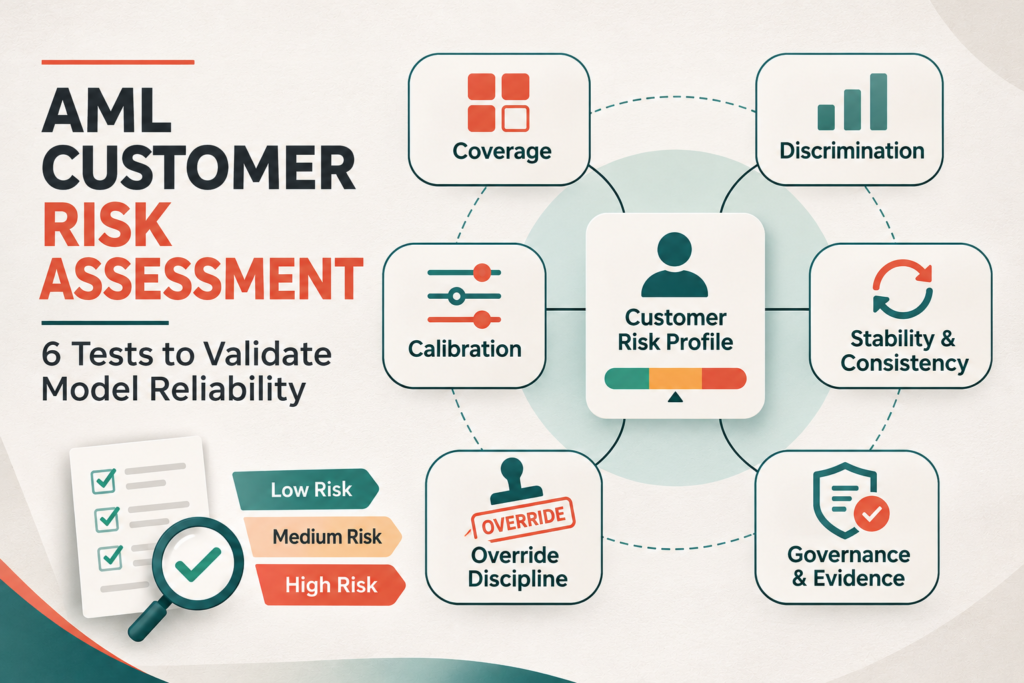
Regulated businesses in the UAE often give their customers a risk rating. Far fewer can prove that the rating leads to the right decision.
A robust AML customer risk assessment in the UAE is a documented, tested method that decides how much due diligence a customer receives, how closely they are monitored and when they are escalated. Under Federal Decree-Law No. 10 of 2025 and its executive regulations, regulators expect you to show why a customer was rated as they were, and that the model behind the rating works.
This guide explains how to test whether your risk assessment model is reliable or not.
What UAE AML Law Requires of Your Customer Risk Assessment
The legal framework changed significantly in late 2025. Federal Decree-Law No. 10 of 2025 on Anti-Money Laundering, Combating the Financing of Terrorism and Proliferation Financing took effect on 14 October 2025. It repealed Federal Decree-Law No. 20 of 2018.
Its executive regulations, Cabinet Resolution No. 134 of 2025, replaced Cabinet Resolution No. 10 of 2019 and came into force on 14 December 2025. Together they apply across all seven emirates to financial institutions, designated non-financial businesses and professions (DNFBPs) and virtual asset service providers.
For customer risk assessment, the practical requirements include:
- A risk-based approach. Article 19 of the Decree-Law and Article 5 of the Cabinet Resolution require you to identify, assess and understand your crime risks in proportion to the nature and size of your business.
- Multiple risk factors. Customer, country or geographic, product, service, transaction and delivery channel risk must all be considered before an overall risk level is set.
- Use of national findings. The results of the UAE National Risk Assessment and sectoral assessments must inform your own assessment and mitigation measures.
- Enhanced due diligence for higher risk. Higher-risk customers and relationships must receive enhanced measures, including senior management approval for foreign politically exposed persons.
- Up-to-date information. Customer due diligence records must be kept current, with particular emphasis on high-risk customers.
- Proliferation financing. Proliferation financing risk now sits alongside money laundering and terrorist financing within customer risk profiling and enhanced due diligence.
- Senior management accountability. Management is expected to approve policies and oversee high-risk relationships personally.
In short, the law no longer accepts a rating that exists only to be filed. The rating must drive a decision, and the decision must be defensible.
Six Tests of Whether Your Risk Model Is Reliable
A model can look sophisticated and still fail in practice. These six tests help you find out.
1. Coverage: does the model see all material risks?
Check that every risk dimension the law names is represented, and that the data feeding each one is complete.
- Are customer type, ownership complexity, geography, products, delivery channels and transaction behaviour all scored?
- Is proliferation financing exposure, such as dual-use goods or higher-risk jurisdictions, captured?
- Are beneficial owners, not just the legal entity, assessed?
- What happens when data is missing? A blank field should never default to low risk.
2. Discrimination: does the model separate high risk from low risk?
A model that rates almost every customer medium, or one that rates a large share of customers high, is not distinguishing risk. Either outcome suggests weak weightings.
- Review the distribution of ratings across your customer base.
- Test whether customers you know to be higher risk, such as those later subject to suspicious transaction reports, were rated appropriately at onboarding.
- Check that a single factor, such as country, cannot push every customer into one band regardless of other facts.
3. Calibration: do the weightings reflect your real exposure?
Weightings are the model. They should flow from your enterprise-wide risk assessment, not from a vendor default.
- Can you explain why each factor carries its weight?
- Were weightings adjusted for your sector, whether real estate, precious metals and stones, corporate services, audit or virtual assets?
- Have they been updated since the 2025 legislation and the latest National Risk Assessment findings?
4. Stability and consistency: does it give the same answer twice?
Two customers with identical profiles should receive identical ratings. Run a sample of comparable customers through the model and look for unexplained differences.
- Test the same customer entered by different staff members.
- Check whether rating changes follow genuine events, such as a change in ownership or activity, rather than data entry noise.
- Confirm that re-ratings are triggered by events, not only by the calendar.
5. Override discipline: who can change the answer, and why?
Human judgement is valuable. Unrecorded judgement is a weakness.
- Every override of a system rating should be logged with a reason and an approver.
- Very frequent overrides suggest the model does not reflect your customer base. No overrides at all can suggest nobody is challenging it.
- Overrides that only ever move customers downwards deserve particular scrutiny.
6. Governance and evidence: can you prove all of this?
This is where many reviews fail. The model may be sound, but the paper trail is not.
- Is there a named model owner with clear accountability?
- Is there a documented methodology, with approval by senior management?
- Is there evidence of independent testing, with findings, dates and remediation?
- Are rating histories and the rationale for each change retained?
For institutions supervised by the Central Bank of the UAE, the Model Management Standards and Guidance issued in December 2022 treat model risk as a material risk and set expectations on governance, development, usage and independent validation. Businesses outside that regime, including many DNFBPs, will not be bound by those standards in the same way, but they offer a useful benchmark for what good looks like.
How Jitendra Chartered Accountants Can Help
Jitendra Chartered Accountants (JCA) has supported businesses across the UAE since 2001. Our AML specialists work with financial institutions, DNFBPs and growing businesses that need their risk assessment framework to stand up to inspection.
Our AML compliance services in Dubai include:
- Independent review and testing of your customer risk rating model
- Design or recalibration of customer risk assessment methodology aligned to Federal Decree-Law No. 10 of 2025 and Cabinet Resolution No. 134 of 2025
- Enterprise-wide risk assessment, including proliferation financing
- Enhanced due diligence procedures and file reviews
- Development of your AML-CFT framework
- Ongoing AML compliance support
- AML and CFT training for staff and senior management
- goAML registration and reporting support
- Internal audit of your AML controls
Speak to our AML team for a confidential discussion about how your customer risk assessment would stand up to scrutiny.
Frequently Asked Questions
What is an AML customer risk assessment in the UAE?
It is the process of evaluating how likely each customer is to be involved in money laundering, terrorist financing or proliferation financing, using factors such as customer type, geography, products, channels and behaviour. The result determines the level of due diligence and monitoring applied.
Is a customer risk rating mandatory under UAE law?
Yes. Federal Decree-Law No. 10 of 2025 and Cabinet Resolution No. 134 of 2025 require a risk-based approach, which in practice means assessing and recording the risk of each customer so that controls are proportionate.
How often should customer risk ratings be reviewed?
The law requires customer information to be kept up to date, with emphasis on high-risk customers. Most businesses set review cycles by risk band and also re-rate a customer when a trigger event occurs, such as a change in ownership, adverse media or unusual transactions.
Does the risk model need to include proliferation financing?
Yes, under the 2025 framework, proliferation financing is treated as a risk alongside money laundering and terrorist financing. Customer risk profiling and enhanced due diligence should take into account factors such as dual-use goods and higher-risk jurisdictions.