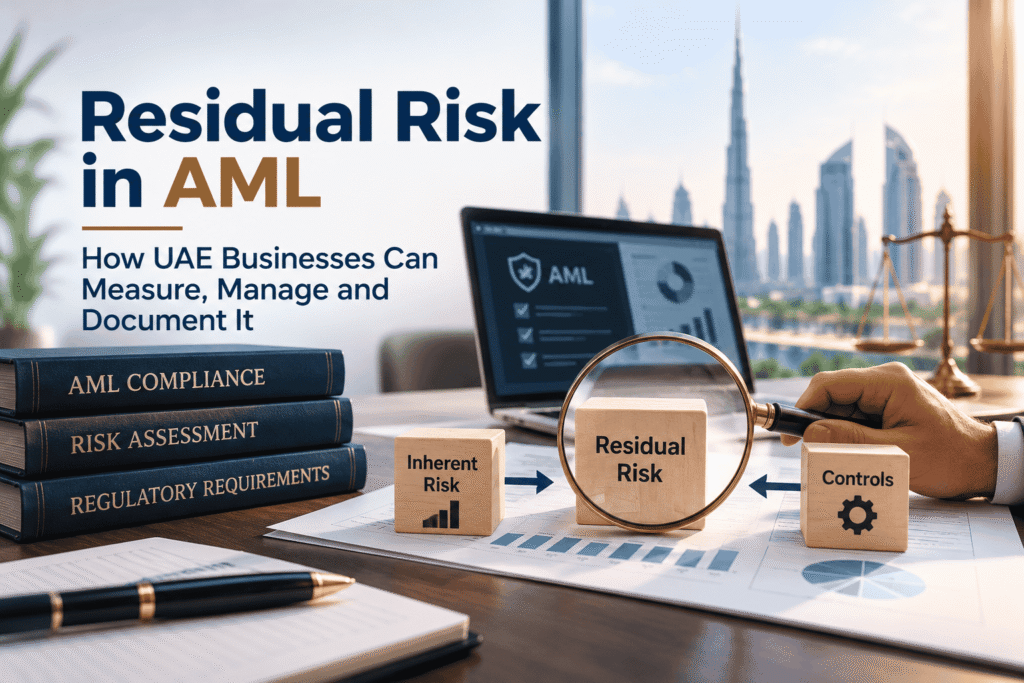
Every UAE business carries some financial crime risk, however good its controls. Residual risk in AML UAE compliance is the risk that remains after your policies, screening, monitoring and training have done their work. Regulators expect you to measure it, document it and keep it within a stated risk appetite.
Since Federal Decree-Law No. 10 of 2025 took effect on 14 October 2025, that expectation has become sharper. This guide explains what residual risk means, how to calculate it, and what a defensible assessment looks like. It is written for DNFBPs, financial institutions, free zone companies and owner-managed businesses.
What Is Residual Risk in AML?
Inherent risk is the exposure your business faces before any controls are applied. Residual risk is what is left once controls are in place and working.
In simple terms, residual risk reflects both how risky your business is and how well your controls actually perform. You do not subtract controls like a number. You judge how far they reduce the likelihood and impact of each risk.
Inherent risk: the raw exposure from your customers, countries, products, delivery channels and transactions.
Control effectiveness: how well your measures work in practice, not how they look on paper.
Residual risk: the net exposure that remains, which must sit within your risk appetite.
Residual risk is never zero. The aim is to show your supervisor that you understand what remains and have decided, on evidence, what to do about it.
Inherent Risk vs Residual Risk: A Practical Comparison
Starting point: inherent risk is assessed first, before controls are considered. Residual risk is assessed after controls are tested.
What it tells you: inherent risk shows where you are exposed. Residual risk shows whether your controls are enough.
How often it changes: inherent risk shifts when your business model changes. Residual risk shifts whenever a control improves, weakens or fails.
Who needs to see it: both belong in your business risk assessment, and your senior management should approve the residual rating.
How to Assess Residual Risk: A Six-Step Approach
Step 1: Map your inherent risks
Review your customers, geographies, products, services, delivery channels and third parties. A business onboarding remote customers from high-risk jurisdictions carries a different profile from a local, face-to-face service provider.
Step 2: Rate likelihood and impact
Score each risk scenario. For example: “a customer uses a shell company to hide beneficial ownership.
Step 3: List your controls
Include customer due diligence, beneficial owner checks, sanctions screening, transaction monitoring, goAML reporting procedures and staff training.
Step 4: Test control effectiveness
This is where many businesses fall short. A policy that exists but is not followed does not reduce risk. Use sampling, file reviews, system testing and independent audit.
Step 5: Determine the residual rating
Combine the inherent score with your control-effectiveness result. Record the reasoning, not just the colour on a heat map.
Step 6: Compare against risk appetite and act
If residual risk sits above your stated appetite, you need stronger controls, a change in business practice, or a documented decision by senior management.
Best Practices for Managing Residual Risk
- Refresh your enterprise-wide risk assessment at least annually and after any major change in business activity.
- Align your assessment with the UAE National Risk Assessment and current MoET circulars on high-risk countries.
- Test controls independently and keep the evidence.
- Keep customer files current through periodic review.
- Train staff by role, so each team knows which risks it owns.
- Report suspicions through the goAML portal without delay and without tipping off the customer.
- Record the residual rating, the rationale and senior management’s decision.
Frequently Asked Questions
What is residual risk in AML?
It is the money laundering, terrorist financing and proliferation financing risk that remains after your controls have been applied and tested.
How often should I update my risk assessment?
At least annually, and whenever your customers, services, geographies or delivery channels change materially.
Who must carry out an AML risk assessment in the UAE?
Financial institutions, VASPs and DNFBPs, including real estate brokers, dealers in precious metals and stones, company service providers, and independent accountants and auditors when carrying out specified activities.
What happens if my residual risk is too high?
You should strengthen controls, adjust your business activity, or obtain a documented senior-management decision. Ignoring it is the riskiest option.
Can an external consultant prepare the assessment?
Yes. Many businesses use an external adviser for objectivity, though accountability for the assessment stays with your senior management.
How Jitendra Chartered Accountants Can Help
Jitendra Chartered Accountants (JCA) has supported UAE businesses with audit, accounting, tax and compliance since 2001. Our AML team works with you to:
- Prepare a documented business risk assessment aligned to current UAE law
- Test your controls and rate residual risk with supporting evidence
- Design or update your AML/CFT framework
- Provide ongoing AML compliance support
- Deliver role-based AML training
- Handle goAML reporting with accuracy and discipline
Talk to our UAE AML compliance experts today to book a consultation.