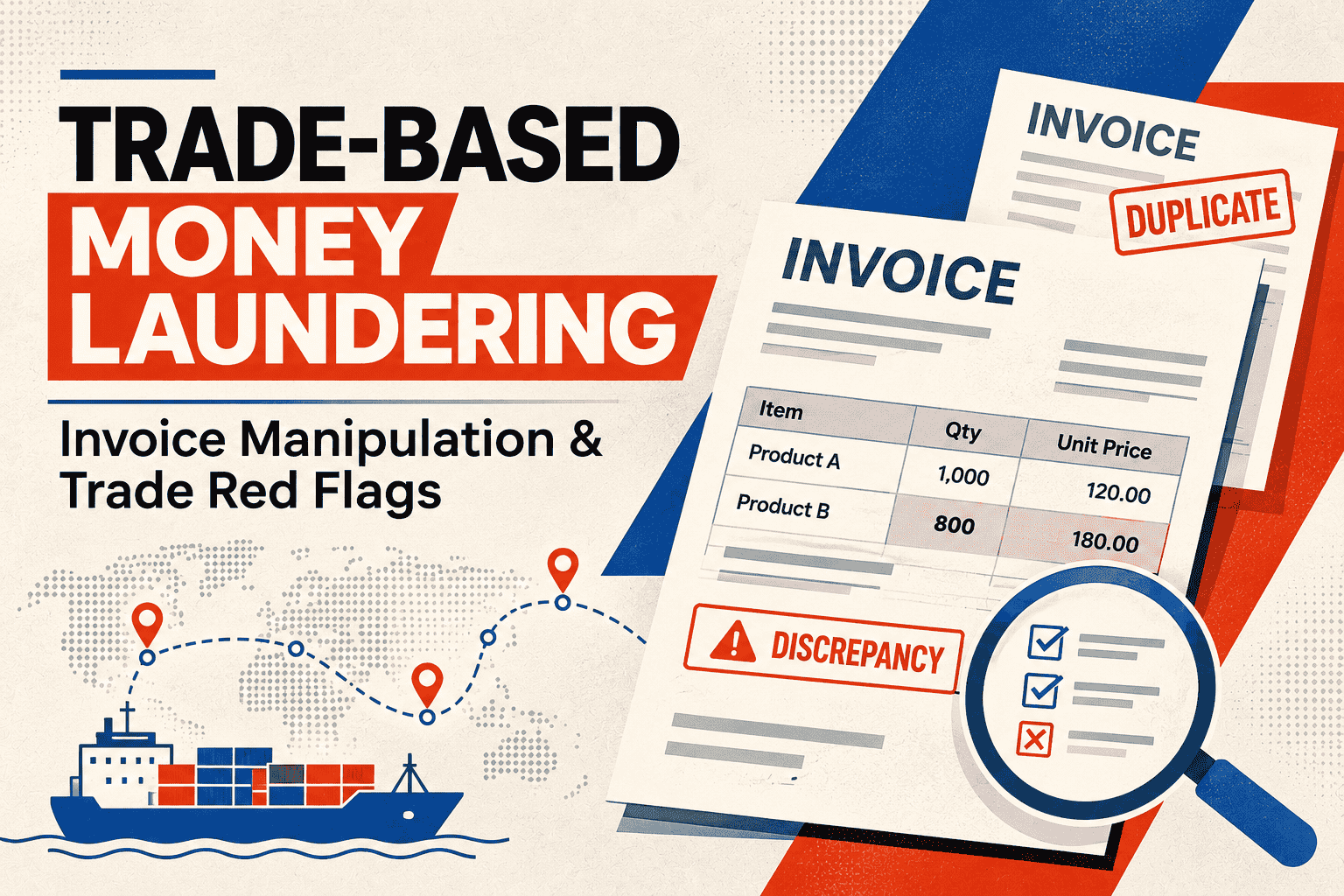
Trade-based money laundering (TBML) in the UAE is not a risk associated with banks. If your business imports, exports, re-exports, trades commodities or audits companies that do, your invoices, contracts and shipping records are now part of the UAE’s financial crime perimeter.
The UAE has one of the world’s busiest trade corridors, with deep free zone networks, large re-export volumes and active gold and commodity markets. That scale is a strength. It is also exactly why criminals try to hide illicit value inside ordinary-looking trade.
This guide explains how TBML works, how to detect invoice manipulation and over-invoicing, what UAE law and regulators expect, and how Jitendra Chartered Accountants (JCA) helps businesses build controls that stand up to inspection.
What Is Trade-Based Money Laundering?
TBML is the use of trade transactions to disguise the proceeds of crime and move value across borders. The FATF describes it as disguising illicit proceeds and moving value through trade, often by misrepresenting the price, quantity or quality of goods and services.
The trade itself may look genuine. The paperwork, the pricing or the parties behind it are what have been manipulated.
TBML is hard to detect because:
- Genuine and false trade often run through the same accounts
- Pricing for many goods is subjective, particularly for gold, jewellery, electronics and used goods
- Multiple jurisdictions, free zones and intermediaries make the picture fragmented
- Documents can be real in form but false in substance
Why the UAE Faces Elevated TBML Exposure
The UAE’s National Risk Assessment recognises money laundering as a key threat, with a strong link to the misuse of corporate structures and trade. Re-exports, transshipment, gold and precious stones, and complex ownership chains all feature in regulator guidance.
Sectors that regulators and industry commentary commonly flag include:
- Gold, precious metals and stones
- General trading and re-export businesses
- Electronics, vehicles and spare parts
- Commodities such as metals, oil products and food items
- Companies using free zone and offshore structures for trade
If a client in any of these sectors sits in your portfolio, TBML should be on your risk register.
Core TBML Techniques: Invoice Manipulation, Over-Invoicing and Beyond
Over-invoicing and under-invoicing
This is the classic technique. Value moves between buyer and seller by deliberately pricing goods above or below fair market value.
Over-invoicing: the importer pays more than the goods are worth. The surplus moves to the exporter as value, often in another jurisdiction.
Under-invoicing: the importer pays less than the goods are worth, and the difference is settled outside the books, or the buyer receives value from the seller.
Multiple invoicing
One shipment is invoiced several times, or one invoice is paid in several instalments through different banks. Each payment looks routine, but together they exceed the true value of the trade.
Over-shipment and under-shipment
The quantity on the paperwork differs from the real shipment. In the most extreme version, a phantom shipment, no goods move at all and only documents and payments exist.
Misrepresentation of quality or description
Goods are described as higher or lower grade than they are, or classified under the wrong customs code, to justify a price that does not match reality.
Complex and layered trade structures
Transshipment through third countries, back-to-back contracts, intermediary traders, shell companies and third-party payers all increase distance between the true buyer, the true seller and the true source of funds.
Red Flags: How to Detect Invoice Manipulation in Practice
The FATF and the Egmont Group’s March 2021 risk indicators group TBML red flags into four areas: structural, trade activity, trade document and commodity, and account and transaction activity. One indicator alone does not prove laundering. It may justify closer review.
Invoice and document red flags
- Invoice price materially above or below market benchmarks, without a commercial reason
- Descriptions that are vague, generic or inconsistent across invoice, bill of lading and packing list
- Quantities, weights or values that do not reconcile between documents
- Amended or reissued invoices, or duplicate invoice numbers
- Documents that look altered, or are issued by parties with no clear link to the goods
Customer and structural red flags
- Newly incorporated company with large trade volumes and no operating history
- Trade inconsistent with the customer’s stated business, size or experience
- Registered address shared with many unrelated companies, or with a corporate service provider
- Beneficial ownership that is unclear, layered or reluctant to be disclosed
- Business conducted through a free zone entity with no visible local operations
Payment and transaction red flags
- Payments from or to third parties unconnected to the contract
- Payments routed through several countries before reaching the origin
- Unexpected use of cash, or settlement that does not match the trade terms
- Frequent changes to payment instructions or bank accounts
- Sudden spikes in trade volume without a business explanation
Route and commodity red flags
- Shipment routes that are illogical, longer than necessary or involve high-risk jurisdictions
- Gold or commodities declared as originating from countries with no known production
- Dual-use goods, or links to sanctioned jurisdictions or persons
What UAE Law and Regulators Expect
The UAE’s core AML law is Federal Decree-Law No. 10 of 2025 on Anti-Money Laundering, Combating the Financing of Terrorism and Proliferation Financing. It was issued on 30 September 2025, came into force on 14 October 2025, and repealed Federal Decree-Law No. 20 of 2018.
Its implementing regulation is Cabinet Resolution No. 134 of 2025, which replaced Cabinet Decision No. 10 of 2019.
Key points that matter for TBML:
A lower evidentiary threshold. Money laundering can be established where a person knows, or where there are sufficient indications or evidence to believe, that funds are criminal proceeds. Knowledge can be inferred from factual and objective circumstances. Ignoring obvious invoice anomalies is therefore a real legal risk.
Wider corporate liability. Companies can be held liable for a broader range of offences committed by their representatives, managers or agents, and senior management accountability is a growing regulatory focus.
Risk-based obligations. Financial institutions and Designated Non-Financial Businesses and Professions (DNFBPs) must identify and assess their money laundering, terrorist financing and proliferation financing risks, and apply controls in proportion to them.
Customer due diligence and beneficial ownership. Ownership must be identified and verified, with the 25% beneficial ownership threshold under Cabinet Decision No. 109 of 2023.
Reporting through goAML. Suspicious transactions and activities must be reported to the UAE Financial Intelligence Unit, and records must be retained for at least five years.
Central Bank guidance on TBML and transhipment
On 16 April 2026, the Central Bank of the UAE (CBUAE) issued updated AML/CFT/CPF guidance, including a dedicated Guidance on Risks Related to Trade-Based Money Laundering and Transhipment for licensed financial institutions and registered hawala providers.
The guidance points institutions towards reviewing trade documents, comparing declared prices with market prices using risk-based sampling, and applying enhanced due diligence to higher-risk trade finance relationships.
If you are not a licensed financial institution, this guidance does not bind you directly. It does, however, show how your bank will assess you, and what questions it will ask about your trade flows.
Ministry of Economy guidance for DNFBPs
Auditors, accountants, dealers in precious metals and stones (DPMS), real estate agents and corporate service providers are supervised by the Ministry of Economy and Tourism. Its March 2026 DNFBP guidelines and sector guidance stress risk-based controls, including attention to trade documentation where high-value goods are involved.
For DPMS, a Dealers in Precious Metals and Stones Report (DPMSR) must be filed through goAML for in-scope cash transactions at or above AED 55,000, whether single or linked.
How to Build a TBML Control Framework
A strong TBML framework turns red flags into repeatable, documented actions. A practical structure includes:
- Enterprise-wide risk assessment. Map which customers, products, countries, routes and payment methods expose you to trade risk.
- Customer due diligence at onboarding. Understand what the customer trades, with whom, where and at what scale. Verify beneficial owners and the rationale for the structure.
- Enhanced due diligence for high-risk trade. Request contracts, purchase orders, bills of lading, customs declarations and supplier details.
- Price and quantity checks. Benchmark invoice prices against published market data and document any justified deviation.
- Sanctions and proliferation financing screening. Screen customers, counterparties, vessels, ports and goods against the Local Terrorist List, UN lists and relevant sanctions regimes.
- Transaction monitoring with trade-specific scenarios. Configure alerts for third-party payments, round-tripping, volume spikes and mismatched documents.
- Escalation and reporting. Give staff a clear route to the compliance officer, and file STRs or SARs through goAML where suspicion is formed.
- Training and independent testing. Train teams on trade red flags, and test the framework through an independent AML review or audit.
How Jitendra Chartered Accountants Can Help
JCA supports UAE businesses, DNFBPs and trading companies with practical, regulator-ready AML compliance. For trade-based money laundering risk, we can help you with:
- AML/CFT risk assessments covering trade, customer, geography and payment risk
- AML policies and procedures aligned with Federal Decree-Law No. 10 of 2025 and Cabinet Resolution No. 134 of 2025
- Independent AML audits and compliance reviews that test whether your controls work in practice
- Forensic review of suspicious invoices and trade flows, through our forensic audit and fraud examination services
- Due diligence on counterparties and transactions, through our due diligence audit services
- goAML registration and STR/SAR reporting support
- Staff training on trade red flags and escalation
Our approach is simple: clear advice, evidence-based work and compliance that protects your licence, your banking relationships and your reputation.
Frequently Asked Questions
What is trade-based money laundering in the UAE?
It is the use of trade transactions, such as imports, exports and re-exports, to disguise illicit funds or move value across borders. Common methods include over-invoicing, under-invoicing, multiple invoicing and false descriptions of goods.
What is over-invoicing and why does it matter for AML?
Over-invoicing means charging a price above the real value of goods or services. The excess payment moves value to the seller, often in another country. It is a recognised TBML technique, and unexplained price deviations are a standard red flag.
Does UAE AML law apply to trading companies?
Core obligations apply to financial institutions, DNFBPs and virtual asset service providers. Trading companies that are not regulated still face banking due diligence, sanctions exposure and criminal liability if they knowingly, or with sufficient indications, take part in laundering. Dealers in precious metals and stones have specific reporting duties.
Who must report suspicious trade transactions?
Regulated entities must report suspicious transactions or activities to the UAE Financial Intelligence Unit through goAML. The test is suspicion or reasonable grounds to suspect, not proof.
Is one red flag enough to report?
Not on its own. The FATF notes that a single indicator does not establish TBML. You should assess the red flag in context, document your reasoning, and escalate where the overall picture raises suspicion.