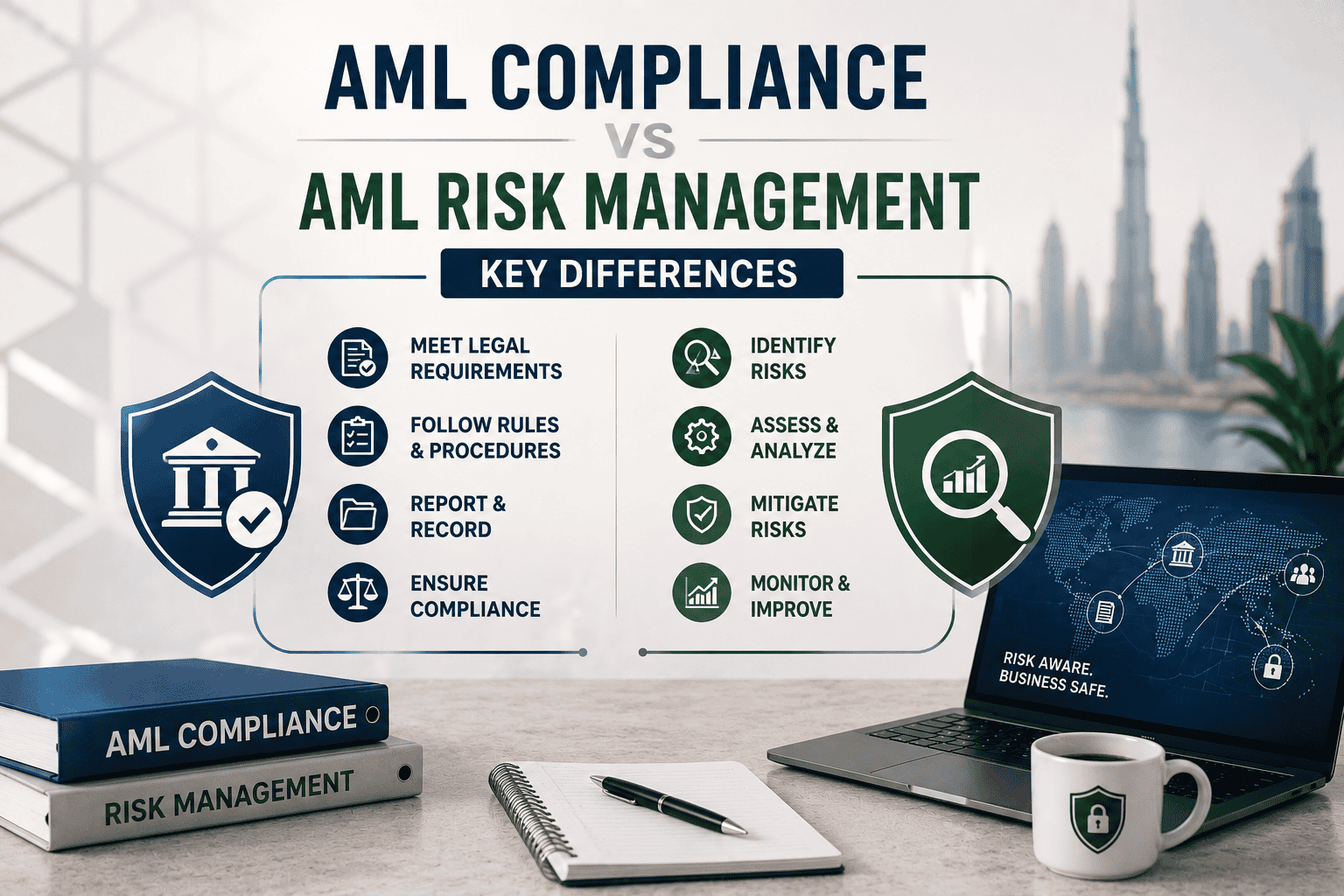
Confusing AML compliance with AML risk management is one of the most common mistakes UAE businesses make, and it can prove costly. Under Federal Decree-Law No. 10 of 2025 on Anti-Money Laundering, Combating the Financing of Terrorism, and Proliferation Financing (the “2025 AML Law”), regulated entities are expected to demonstrate both. Understanding AML compliance vs AML risk management, and how the two work together, is essential for financial institutions, DNFBPs and virtual asset service providers operating in the UAE.
This guide explains what each term means, how they differ, and what the 2025 AML Law and its Executive Regulations, Cabinet Resolution No. 134 of 2025, require of your business.
What Is AML Compliance?
AML compliance refers to the specific legal obligations a business must fulfil under UAE anti-money laundering legislation. It is a defined set of actions mandated by the Central Bank of the UAE (CBUAE), the Ministry of Economy and Tourism (MoET), and other supervisory authorities.
Under the 2025 AML Law and Cabinet Resolution No. 134 of 2025, AML compliance in the UAE typically includes:
- Registering with the goAML portal and relevant regulator
- Appointing a qualified AML compliance officer
- Preparing and maintaining AML/CFT policies, procedures and internal controls
- Conducting Know Your Customer (KYC) and Customer Due Diligence (CDD) checks
- Screening customers against UN and local sanctions lists
- Monitoring transactions and filing Suspicious Transaction Reports (STRs) and Suspicious Activity Reports (SARs)
- Retaining records for the statutory retention period
- Delivering regular AML/CFT training to staff
Failure to meet these obligations can result in penalties of up to AED 100 million, licence suspension, or business dissolution under the enhanced enforcement powers introduced by the 2025 AML Law.
What Is AML Risk Management?
AML risk management is the broader, ongoing process of identifying, assessing and mitigating the money laundering, terrorist financing and proliferation financing risks a business faces. Rather than a fixed checklist, it is a strategic exercise that adapts as your customer base, products, geographic exposure and delivery channels change.
A sound AML risk management framework typically involves:
- Conducting an Enterprise-Wide Risk Assessment (EWRA) covering customers, products, transactions, delivery channels and geography
- Applying a risk-based approach, with Enhanced Due Diligence (EDD) for high-risk customers and simplified measures for low-risk relationships
- Continuously updating the risk assessment in line with the UAE National Risk Assessment
- Building governance structures where senior management owns AML risk oversight
- Using technology such as transaction monitoring and name screening software to detect emerging risks
AML Compliance vs AML Risk Management: The Key Differences
While closely linked, AML compliance and AML risk management are not the same thing. The table below sets out the main distinctions.
Compliance Is a Subset of Risk Management
AML compliance is the set of mandatory actions a regulated entity must complete. AML risk management is the wider strategic framework within which those actions sit. In practice, AML compliance is a subset of AML risk management, not the other way around.
Reactive vs Proactive
- AML compliance is reactive: it responds to a fixed set of rules issued by the regulator
- AML risk management is proactive: it anticipates emerging typologies, sectoral risks and predicate offences before they materialise
Legal Obligation vs Strategic Process
- AML compliance is a legal requirement under the 2025 AML Law and its Executive Regulations
- AML risk management is a strategic, business-specific process, since no two entities face identical risk exposure even within the same sector
Fixed Checklist vs Continuous Cycle
- AML compliance obligations are largely fixed for a given reporting period
- AML risk management is never “complete”; risk assessments must be reviewed and updated regularly as the business and its environment evolve
How the 2025 UAE AML Law Changed the Compliance and Risk Landscape
Federal Decree-Law No. 10 of 2025 came into force on 14 October 2025, repealing the earlier Federal Decree-Law No. 20 of 2018. Its Executive Regulations, Cabinet Resolution No. 134 of 2025, took effect on 14 December 2025. Together, they represent the most significant overhaul of the UAE’s AML/CFT framework to date, and they raise the bar for both compliance and risk management. Key changes include:
- Proliferation financing recognised for the first time as a distinct criminal offence
- Direct regulation of virtual asset service providers, with stricter licensing and reporting requirements
- Expanded beneficial ownership transparency obligations
- Extended powers for the Financial Intelligence Unit, including asset-freezing authority
- Higher penalties, with fines of up to AED 100 million for serious breaches
- A stronger, explicit requirement for entities to apply a risk-based approach aligned with the National Risk Assessment
For businesses across the DIFC, ADGM, mainland UAE and free zones, this means AML compliance programmes and AML risk management frameworks built under the 2018 law must be reviewed, updated and, in many cases, rebuilt to reflect current legislation.
Why Your Business Needs Both
Treating AML compliance and AML risk management as separate, standalone exercises is a common and costly error. A business can technically tick every compliance box and still remain exposed to money laundering risk if its underlying risk assessment is outdated or superficial. Equally, a sophisticated risk management strategy offers little protection if it is not translated into the specific, auditable actions the regulator expects.
The most resilient AML programmes in the UAE combine both:
- A risk-based AML compliance framework tailored to the entity’s customer base, products and geographic footprint
- Documented, regularly updated risk assessments that directly inform CDD, EDD and transaction monitoring thresholds
- Governance and reporting lines that give senior management visibility of both compliance status and emerging risk
Common Mistakes UAE Businesses Make
- Relying on AML policies drafted under the repealed 2018 law without updating them for the 2025 AML Law
- Treating the annual risk assessment as a one-off document rather than a living process
- Appointing an AML compliance officer without giving them the authority or resources to act on risk findings
- Applying the same due diligence measures to every customer, regardless of risk rating
- Failing to train staff on new obligations relating to virtual assets and proliferation financing
Frequently Asked Questions
Is AML risk management a legal requirement in the UAE?
Yes. The 2025 AML Law and Cabinet Resolution No. 134 of 2025 require regulated entities to identify, assess and document their money laundering and terrorist financing risks as part of a risk-based approach, making risk management a compliance obligation in itself.
Which businesses must comply with the 2025 AML Law?
Financial institutions, Designated Non-Financial Businesses and Professions (DNFBPs) such as auditors, real estate agents and company service providers, and virtual asset service providers are all within scope, along with other high-risk sectors identified in the National Risk Assessment.
What happens if a business only focuses on compliance and ignores risk management?
It remains exposed to undetected money laundering activity and may struggle to justify its due diligence decisions to regulators during an inspection, even if standard reports have been filed on time.
Can outsourcing AML compliance and risk management reduce business risk?
Yes. Engaging experienced UAE AML consultants ensures your compliance framework and risk assessment methodology stay aligned with the latest CBUAE, MoET and FATF requirements, reducing the likelihood of regulatory penalties.
Strengthen Your AML Framework with Jitendra Chartered Accountants
Understanding AML compliance vs AML risk management is the first step. Building a framework that satisfies UAE regulators while genuinely protecting your business requires specialist expertise. Jitendra Chartered Accountants supports financial institutions, DNFBPs and VASPs across the UAE with AML/CFT policy documentation, risk assessments, AML compliance officer support, transaction monitoring reviews and staff training aligned with Federal Decree-Law No. 10 of 2025.
Contact Jitendra Chartered Accountants today to schedule an AML compliance review and ensure your business is fully aligned with the UAE’s latest AML legislation.