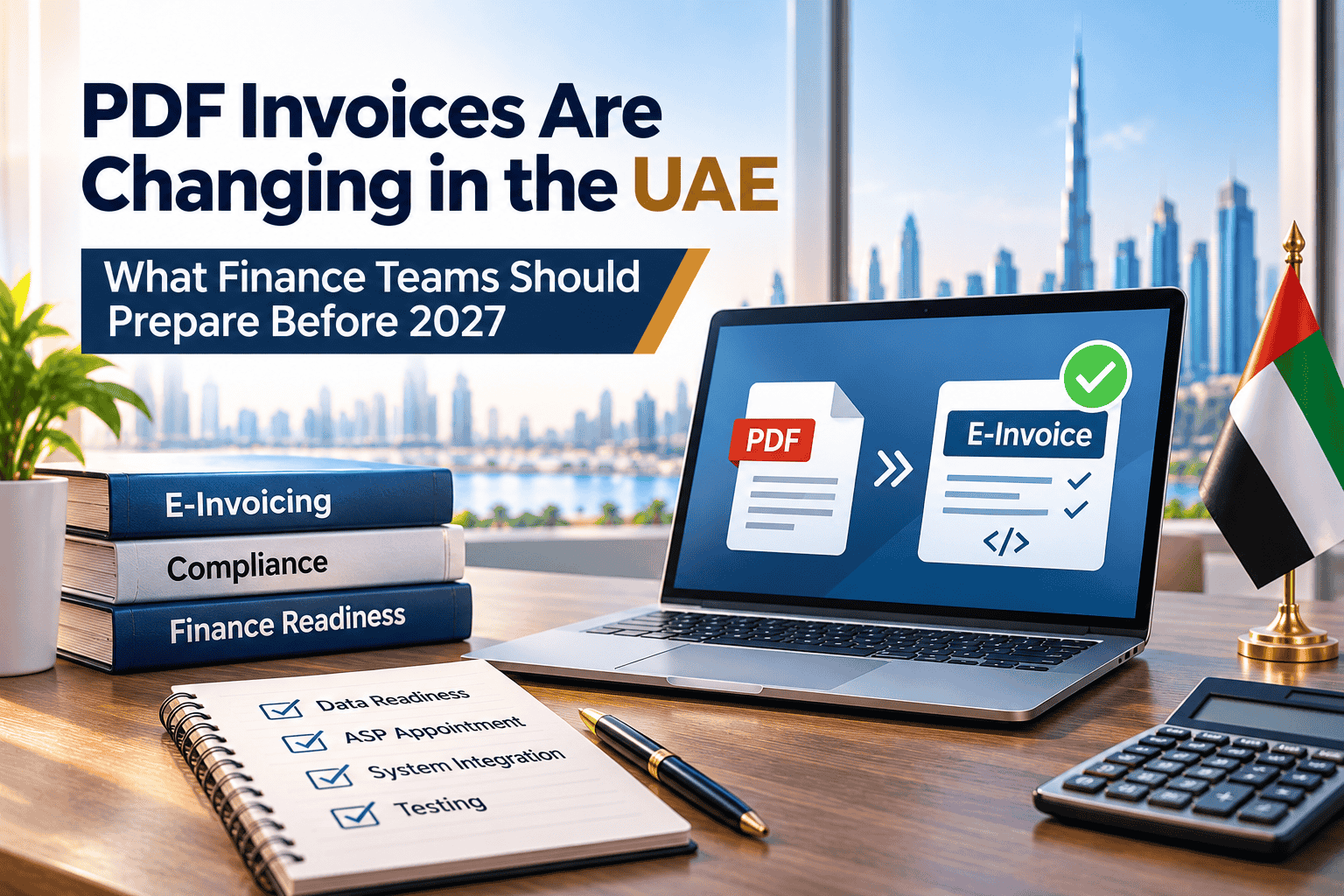
Are we ready to move beyond emailing PDF invoices? For finance teams, the answer depends on what happens behind the document: where customer details sit, how tax is calculated and whether billing software can exchange structured data.
We help businesses address these accounting and compliance questions through our work at Jitendra Chartered Accountants (JCA). Our services include accounting, bookkeeping and tax advisory, alongside dedicated e-invoicing assistance. We recommend starting with the records behind your invoices, before changing their appearance.
What Must Finance Teams Prepare for UAE E-Invoicing?
An emailed PDF does not qualify as an e-invoice under the UAE framework. The required invoice contains structured data that systems exchange electronically and report to the Federal Tax Authority (FTA). Saving an existing document under a different filename will not meet that requirement.
Confirm Your UAE E-Invoicing Deadline
Businesses within scope with annual revenue of AED 50 million or more must appoint an Accredited Service Provider (ASP) by October 30, 2026. Mandatory implementation starts on January 1, 2027.
The appointment deadline was extended; the implementation date was not. Finance managers need both milestones in their plans. Signing a provider agreement leaves the connection, testing and staff preparation to complete.
Identify Which Transactions Fall Within Scope
Start with your sales ledger. Separate business customers from consumers, then identify government contracts and transactions requiring closer review.
The framework covers business-to-business and business-to-government transactions, subject to specific exclusions. Free zone status does not automatically remove an obligation, and scope extends beyond VAT-registered businesses. Consumer transactions currently fall outside mandatory coverage.
Clean Customer and Invoice Data
A billing clerk may recognise an abbreviated customer name. An electronic validation process needs the required information in the correct fields. Review sample invoices against the underlying customer records.
- Confirm legal names and addresses.
- Verify applicable tax identifiers.
- Review tax categories and calculations.
- Resolve duplicate customer records.
Correct the source record when something is wrong. Editing the PDF leaves the same error waiting for the next invoice.
Agree How Your Software Will Connect
Ask your software team to demonstrate how invoice data will reach the appointed Accredited Service Provider (ASP). A PDF export button does not answer that question.
Under the Ministry’s model, businesses supply invoice data in an agreed format. The ASP validates it and converts it into the UAE standard XML format where necessary. Establish who handles that conversion before deciding whether your existing accounting software needs replacement.
Keep PDF Copies Where the Transition Requires Them
Do not switch off PDF generation without reviewing your customers’ readiness. Official guidance requires regular tax invoices, such as PDFs, alongside electronic tax invoices when the buyer has not yet implemented e-invoicing.
That transitional copy serves a practical purpose. It does not replace the supplier’s electronic invoicing obligation.
Why Smaller UAE Businesses Should Prepare Early
The Ministry of Finance identifies 82% of UAE businesses as microbusinesses. The transition therefore reaches far beyond companies with large finance departments.
For businesses below the first revenue threshold, the published timetable requires ASP appointment by March 31, 2027, and implementation by July 1, 2027. A later deadline leaves room to prepare, but customer records and software connections still need attention.
A small team could begin with its most common invoice type. Trace the information from customer setup through approval and delivery, noting every place someone manually changes it.
Test Invoice Handling Before Going Live
A successful sample transmission is a starting point. Finance teams also need to know what happens when an invoice fails validation or a customer needs a correction. Build those situations into the test plan.
- Send and receive sample invoices.
- Test credit notes against original invoices.
- Follow rejected records through correction.
- Retrieve stored records for review.
Give each unresolved issue an owner. During testing, ask someone outside the implementation team to follow the written process. Missing instructions are easier to fix then than during a busy billing run.
The Ministry’s readiness guidance calls for testing invoice exchange and reporting, with responsibilities agreed for resolving errors.
Prepare for E-Invoicing With Jitendra Chartered Accountants
Where does your current invoice process need work? We offer readiness assessments and compliance advice through our UAE e-invoicing services. Our team also assists with ASP selection, coordinates integration and supports testing alongside your chosen provider.
We can help you turn the findings into an implementation plan grounded in your actual billing process. Contact Jitendra Chartered Accountants to arrange an e-invoicing readiness assessment.
FAQs
Are PDF invoices accepted as UAE e-invoices?
No. A PDF attachment lacks the structured invoice data exchanged through accredited providers and reported electronically under UAE e-invoicing requirements.
When must UAE businesses implement e-invoicing?
Implementation follows phased deadlines. Your revenue category determines timing, while transaction scope and specific exclusions determine which invoices need conversion.
Does UAE e-invoicing apply to businesses without VAT registration?
VAT registration alone does not decide scope. Businesses without VAT registration may still need electronic invoicing for covered business transactions.
Must businesses replace their accounting software for e-invoicing?
Existing software may remain usable if it supplies the required invoice data and connects successfully with your accredited service provider.
How does JCA help businesses prepare for UAE e-invoicing?
JCA offers readiness assessments, compliance advice, provider selection assistance, integration coordination and testing support, alongside its accounting and tax services.